Photo property of National Archives of Ireland, published with permission.
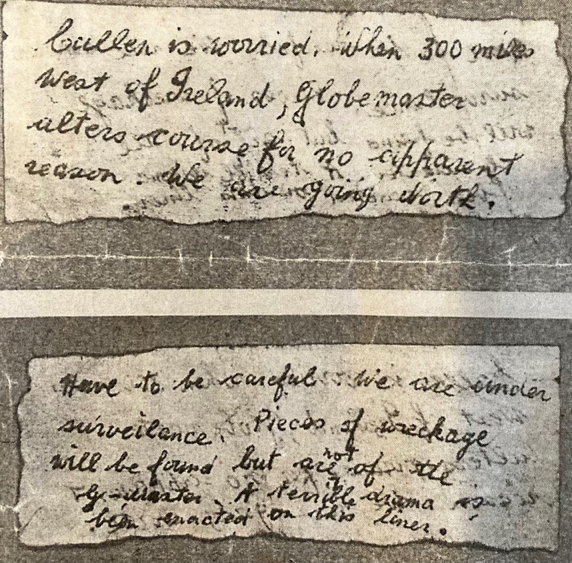
As investigations began winding down into the ditching of 49-244, all of which proved inconclusive, a farmer in the southwestern Irish coastal town of Renvyle reporting coming across a battered paint can while beachcombing one day. He opened the can, and inside was a strange message: "Cullen is worried. When 300 miles west of Ireland, Globemaster alters course for no apparent reason. We are going north."
On the opposite side, the message continued: "Have to be careful. We are under surveilance. Pieces of wreckage will be found but are not of the G-master. A terrible drama is being enacted on this liner."
The farmer took the message to a local police station. The U.S. Air Force dispatched an officer to investigate. The Air Force took the message seriously enough that it began analyzing handwriting samples of personnel known to have been on the aircraft at various points between its initial departure from Walker Air Force Base and its final departure from Limestone, Maine. Two airmen who had flown on the plane but exited during a stopover in Louisiana were interviewed. Both were deemed not to be suspects. But the message, dubious as it was, clearly rattled U.S. authorities.
Irish authorities clearly didn't take the message seriously.
A lengthy analysis, now preserved at the National Archives of Ireland, noted numerous aspects of the message and its container that case serious doubts on its integrity. First the container: It was a battered and rusted paint can, which would have had no business being aboard the Globemaster in any case. The top was sealed tight enough to preserve the message inside, even though everything else on the plane had been blown to splinters aside from a valise owned by one of the passengers, Lawrence Rafferty.
The message itself was written with firm penmanship with no sign of the jolts and surges characteristic of a cargo plane whose nickname was "Old Shakey." The writer clearly didn't know the plane's geographic location at the time it veered off course -- more than 600 miles west of the Irish coast. If the writer had been part of the navigation crew, and therefor privy to its geocoordinates, the writer also would have known the reason why the plane was altering its course. The plane unquestionably went south, not north.
And the writer casts everything in mystery -- "Have to be careful" -- as if someone might be reading over his shoulder or somehow monitoring what was happening inside the plane. "We are under surveilance." Finally, the writer refers to the plane as a G-master, which wasn't part of the Air Force vocabulary when referring to a C-124. And the reference to the plane as a "liner" reflected terminology far more common to an Irish or British civilian than an Air Force service member.