The three-level C-124 Globemaster was the largest military cargo plane in existence in 1951. Most of the Globemaster fleet was operated by MATS, the Military Air Transport Service. But SAC commander Gen. Curtis LeMay decided he needed a dedicated force of Globemasters whose pilots and crew were security-vetted and 100 percent under his command -- which meant being ready to go on a moment's notice. Globemaster 49-244, pictured here, was built in 1949 (thus the precuros 49 on its tail number), but it wasn't put into service until late 1950. In this photo, taken in January 1951, the plane sat on loading tarmac at Lakenheath Royal Air Force base.
Flight manifests of SAC C-124s from Walker Air Force Base strongly suggest that the listed cargo and destinations were complete fabrications. Classified flights would take off with thousands of pounds of cargo, only to return to the same Walker base they took off from. Or they would complete circuitous routes with the same cargo they were carrying when they left. Of particular concern was the absence of any flights by 49-244 during this period. (Document supplied by Keith Amsden.)
After the March 1951 disaster, investigators pieced together several schematics depicting where the passengers, crew and cargo were placed in the plane before takeoff. The pictured schematic was to help investigators visualize the positioning of the plane's propeller assembly in relation to control cables and radio racks in order to make the argument that a thrown propeller might have sliced through the plane's midsection. Damage to the radio boxes would have destroyed the crew's ability to send out an emergency alert. Severed control cables would have rendered the plane uncontrollable. Investigators thought this was the best explanation for what happened. What they failed to explain was how the plane could fly in a straight line for nearly 300 miles before ditching smoothly enough in the Atlantic for survivors to have escaped on life rafts.
Reports from multiple search planes made clear not only that at least some of the plane's occupants had survived the ditching but were aboard one or more rafts and were flashing SOS signals with flashlights. One search plane got close enough to a raft that a crew member aboard the search plane was able to see survivors waving. The search planes were B-29s that had been diverted from their current participation in Operation Evening Star over Europe to join the aerial search. None of the dispatched search planes was equipped with rescue equipment, and their limited fuel supplies forced them to return to base after the survivor sightings were reported.
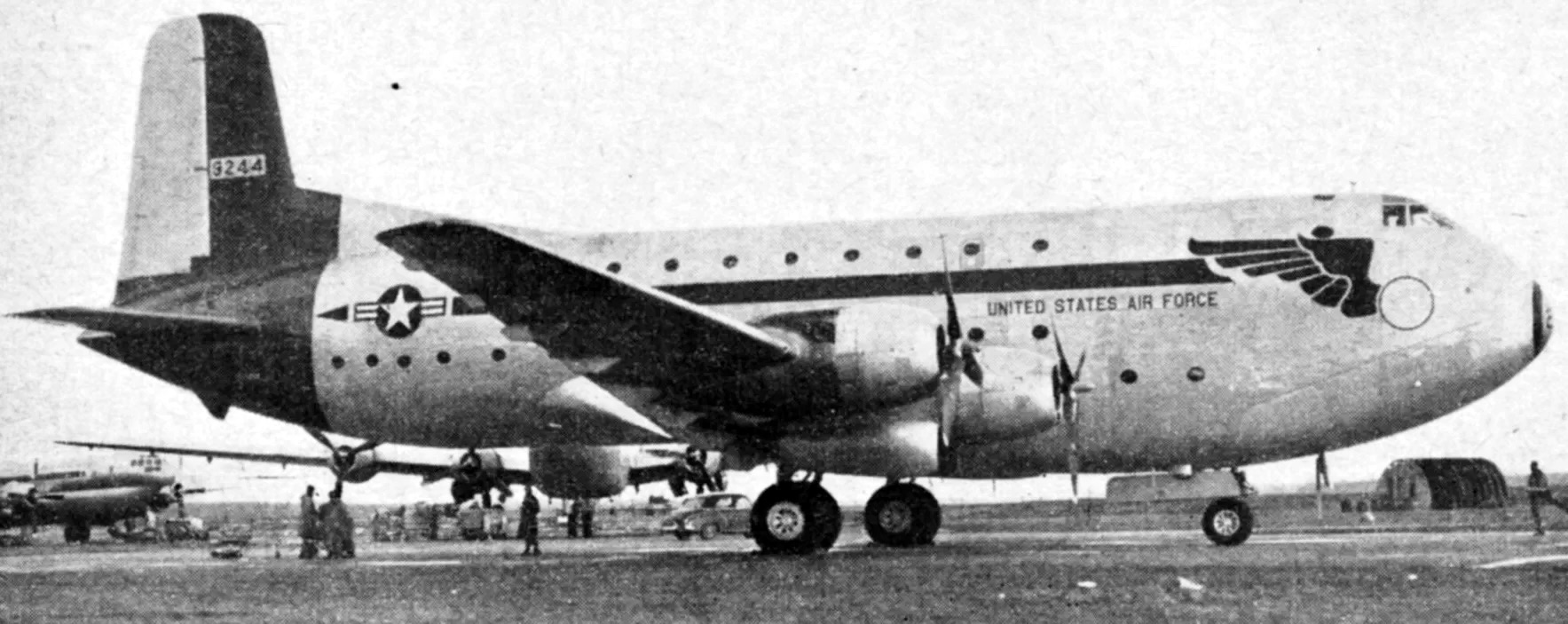 The three-level C-124 Globemaster was the largest military cargo plane in existence in 1951. Most of the Globemaster fleet was operated by MATS, the Military Air Transport Service. But SAC commander Gen. Curtis LeMay decided he needed a dedicated force of Globemasters whose pilots and crew were security-vetted and 100 percent under his command -- which meant being ready to go on a moment's notice. Globemaster 49-244, pictured here, was built in 1949 (thus the precuros 49 on its tail number), but it wasn't put into service until late 1950. In this photo, taken in January 1951, the plane sat on loading tarmac at Lakenheath Royal Air Force base.
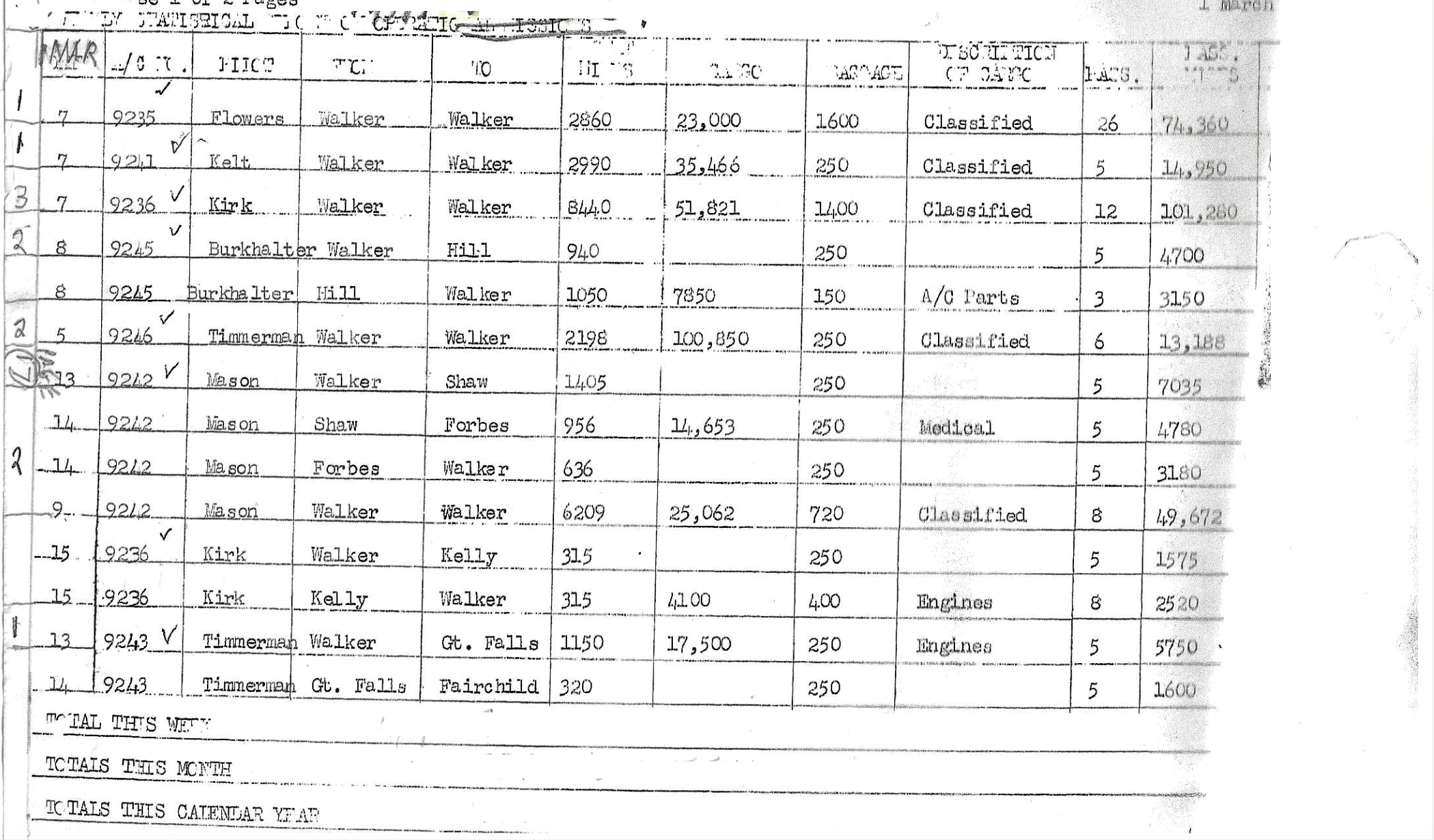 Flight manifests of SAC C-124s from Walker Air Force Base strongly suggest that the listed cargo and destinations were complete fabrications. Classified flights would take off with thousands of pounds of cargo, only to return to the same Walker base they took off from. Or they would complete circuitous routes with the same cargo they were carrying when they left. Of particular concern was the absence of any flights by 49-244 during this period. (Document supplied by Keith Amsden.)
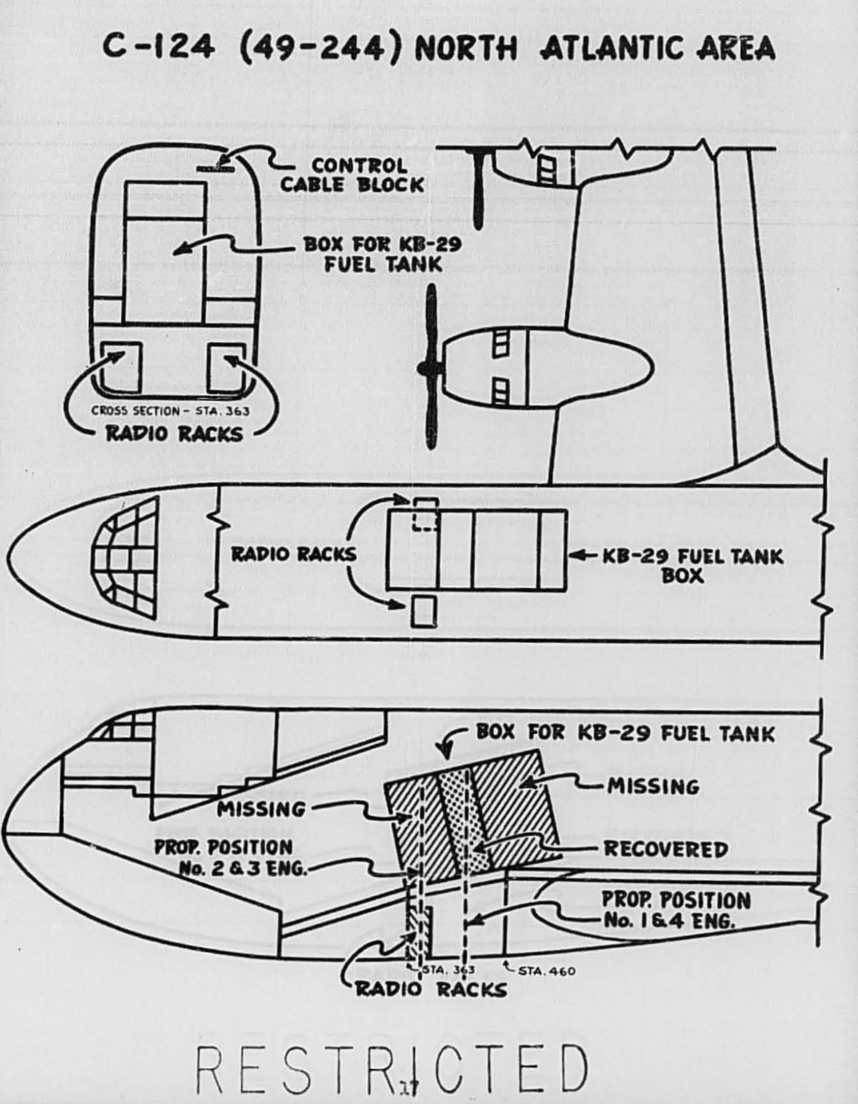 After the March 1951 disaster, investigators pieced together several schematics depicting where the passengers, crew and cargo were placed in the plane before takeoff. The pictured schematic was to help investigators visualize the positioning of the plane's propeller assembly in relation to control cables and radio racks in order to make the argument that a thrown propeller might have sliced through the plane's midsection. Damage to the radio boxes would have destroyed the crew's ability to send out an emergency alert. Severed control cables would have rendered the plane uncontrollable. Investigators thought this was the best explanation for what happened. What they failed to explain was how the plane could fly in a straight line for nearly 300 miles before ditching smoothly enough in the Atlantic for survivors to have escaped on life rafts.
 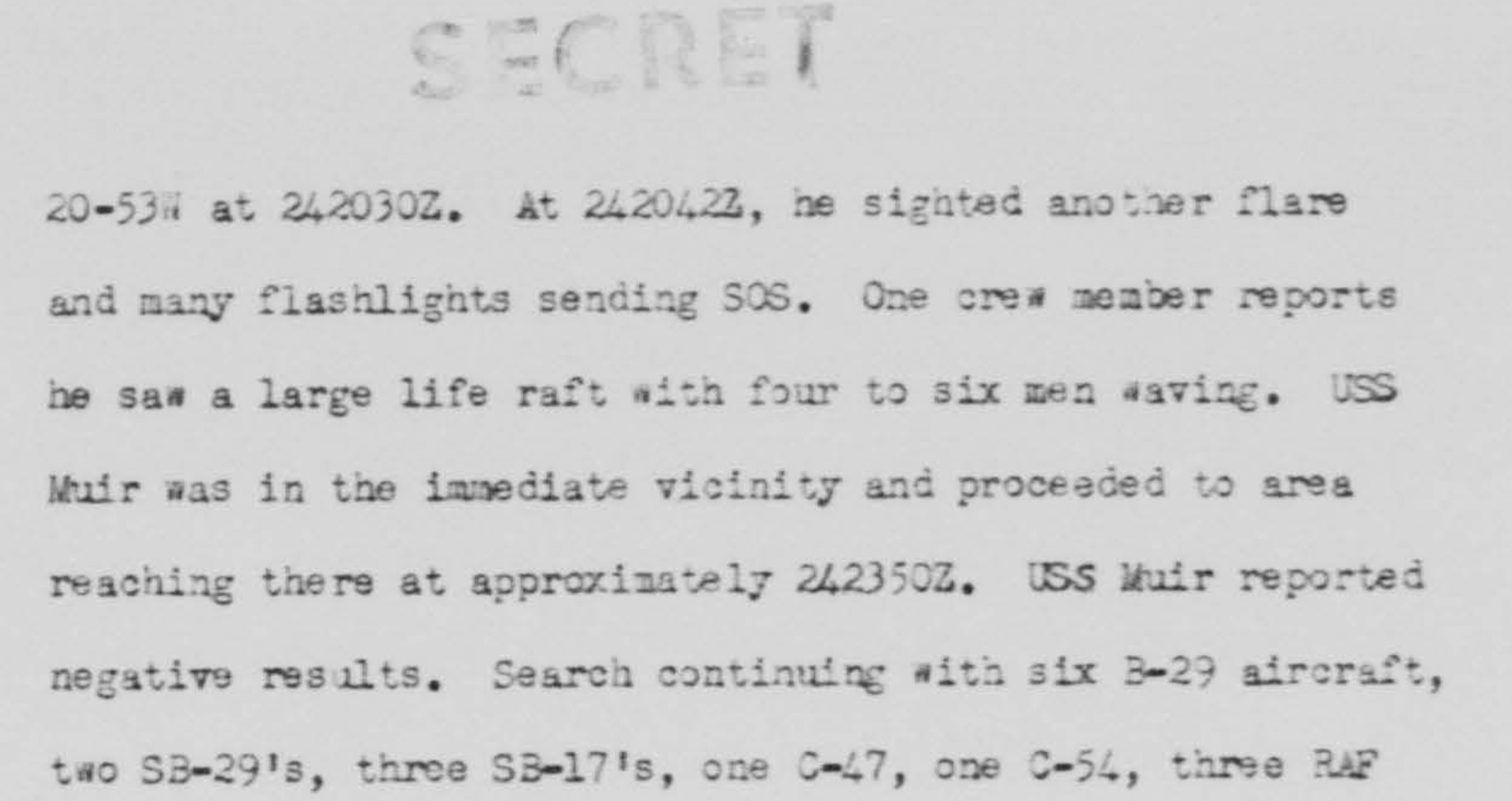 Reports from multiple search planes made clear not only that at least some of the plane's occupants had survived the ditching but were aboard one or more rafts and were flashing SOS signals with flashlights. One search plane got close enough to a raft that a crew member aboard the search plane was able to see survivors waving. The search planes were B-29s that had been diverted from their current participation in Operation Evening Star over Europe to join the aerial search. None of the dispatched search planes was equipped with rescue equipment, and their limited fuel supplies forced them to return to base after the survivor sightings were reported.